 Languages
Languages
Languages
Section 2: In-Process Inspection – The Lifeline Throughout Manufacturing
If production planning is the "neural center," then in-process inspection serves as the manufacturing system's "immune system." It does not wait for the "verdict" on the final product but proactively identifies and isolates variations at every stage and operation, safeguarding product reliability from the source. For critical equipment like the KBZ-type submersible drainage pump, which operates in harsh environments, its superior performance and long service life begin with the absolute reliability of every single component.
Our in-process inspection system is built around three core pillars: "First-Article Inspection, In-Process Inspection, and Final Inspection." Together, they construct a robust quality defense for every KBZ component—from the core motor and impeller to precision mechanical seals.
I. Implementation of the Three Inspection Pillars
1. First-Article Inspection: Setting the "Qualification Benchmark" for Batch Production
The verification of the first produced piece is a mandatory starting point after initiating any batch of components or following a process change.
· Timing: Before machining a new batch of cast blanks, for the first injection-molded part (e.g., terminal box cover) from a new mold, or for the first pump casing end cover produced after a production line changeover.
· Content: A full dimensional check, material verification (initial spectrometer test), and comprehensive visual inspection are conducted against drawings and technical specifications. For example, for the first KBZ pump impeller, key dimensions, flow channel smoothness, and static balance test data are strictly inspected.
· System Record: Results (data, photos) are recorded in real-time via an electronic inspection form in the MES. Batch production for that operation is only allowed by the system after first-article approval, locking in the standard from the outset.
2. In-Process Inspection: The "Quality Radar" for Dynamic Process Monitoring
During batch production, inspectors perform sampling checks at fixed intervals or randomly to monitor process stability.
· Method: Scheduled or quantity-based sampling of components on the production line. For instance, checking the uniformity and thickness of insulating varnish after the motor winding impregnation and curing process, or sampling the 50th and 100th pump housings for critical fit dimensions on the machining line.
· Core Focus: Monitoring characteristics prone to variation from tool wear or environmental factors. In-process inspection evaluates not just results but real-time process capability (CPK), aiming to detect trending deviations, provide early warnings, and prevent batch defects.
· System Integration: Inspection data (measurements, time, equipment ID) is entered via MES mobile terminals. The system automatically generates control charts. If data hits a warning limit, the MES can instantly alert the team leader.
3. Final Inspection: The "Comprehensive Final Review" Before Release
A complete and systematic final verification is performed on components after all processing steps are complete, before they move to assembly or warehouse storage.
· Standard: AQL sampling standards are applied, or 100% inspection is performed for critical parts (e.g., mechanical seals). Inspection covers dimensions, performance, appearance, and cleanliness.
· Performance Verification: For core functional parts, final inspection includes functional testing. For example, final inspection of a KBZ submersible motor includes: withstand voltage test (insulation resistance), no-load performance test (current, speed), and even a brief submersible seal test.
· Status Lock & Traceability: Upon final inspection approval, the inspector confirms in the MES. The batch status is officially updated to "Qualified, Accepted," and a unique inspection lot number is generated. This number becomes the part's lifelong traceable "ID," linking all production and inspection data.
II. System Enablement: The Digital Closed Loop of Inspection
Our inspection activities are not isolated manual tasks but intelligent processes deeply embedded within the digital platform:
1. Task Triggering: Production work orders in ERP/MES automatically trigger corresponding inspection tasks, pushing them to the relevant inspector's terminal.
2. Paperless Standards: Inspectors pull up the electronic inspection instruction sheet for the component on a tablet, which includes drawings, acceptance criteria, and instructional videos, ensuring consistent standards.
3. Automated Data Capture: Digital gauges (digital calipers, micrometers) are used wherever possible, with data transmitted via Bluetooth directly into the system, eliminating manual entry errors.
4. Judgment & Release: The system automatically judges data against limits. After inspector confirmation, results synchronize in real-time with the ERP inventory status. Only components with final inspection approval are released by the ERP system for use in subsequent assembly work orders, enforcing systematic quality control.
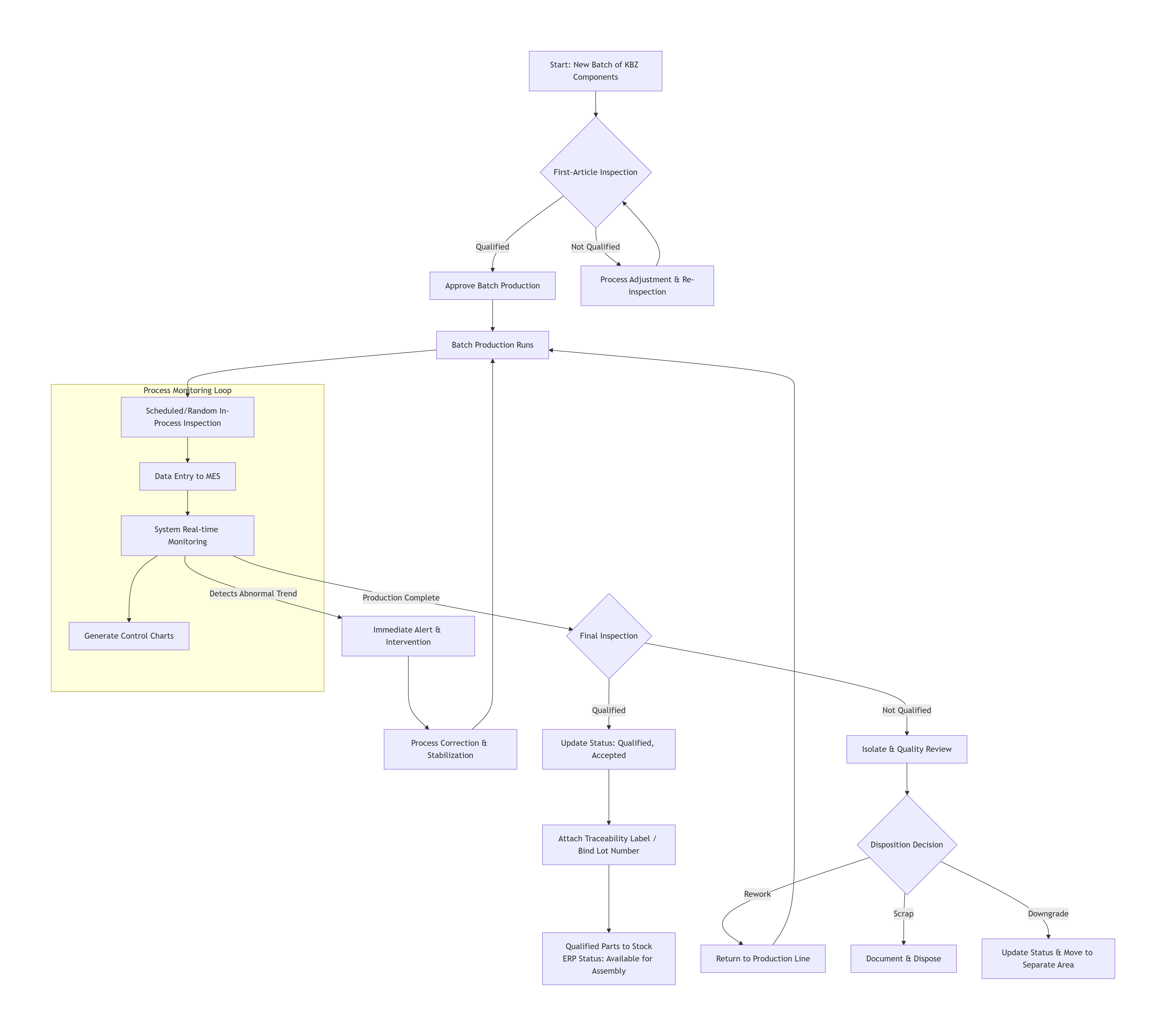
Process Visualization: Panoramic View of KBZ Component In-Process Inspection
The diagram below clearly illustrates the complete closed-loop inspection flow from raw material to qualified component:
Inspection process
Core Value: Beyond "Detection," Focusing on "Prevention"
Through strict adherence to the "Three Inspection System" and leveraging system-enforced processes, we achieve the following for KBZ products:
· A Quality Firewall: Defects are intercepted within the process, preventing them from flowing into costly assembly stages, significantly reducing quality costs.
· Process Transparency: Full-process quality data is visible and traceable, providing a data foundation for process optimization and supplier quality evaluation.
· Continuous Improvement: Statistical analysis based on in-process and final inspection data allows for precise identification of recurring issues, driving fundamental improvements in processes, equipment, or design.
In-process inspection is our practical commitment to the "Reliability in Every Unit" promise for KBZ submersible pumps. It ensures that every component entering final assembly is trustworthy, collectively building the solid foundation for the product's stable operation in deep-water environments.
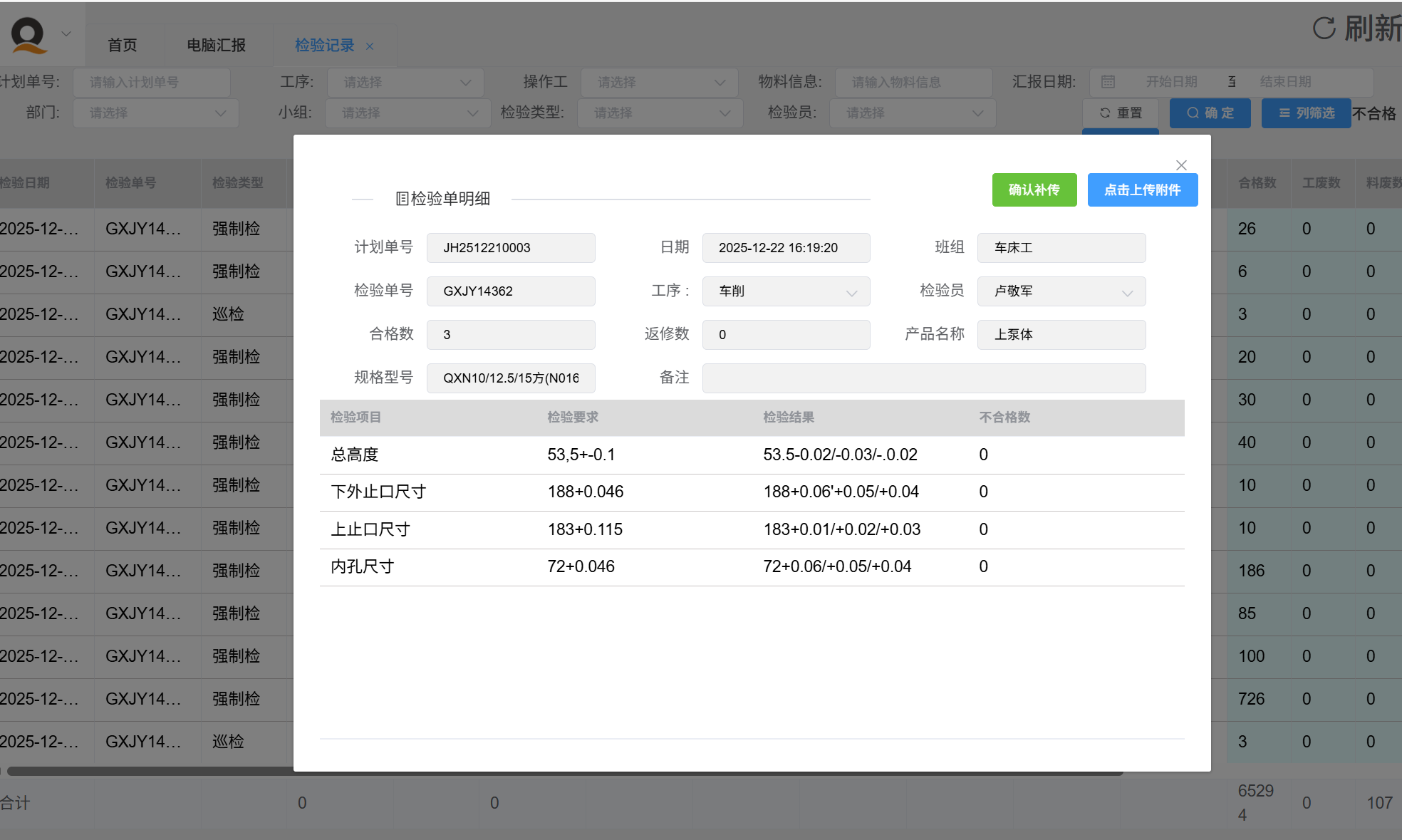
Inspection records within the MES
MES inspection record


 Vincent@kraup.com
 0086-158 8857 7896
 0086-576-86312805
 The industry of Plastic Zone,Daxi Town,Wenling City,Zhejiang Province, China
Copyright © 2025 Kraup® All Right Reserved. Designed & SEO by followala.cn Sitemap | XML
Friendship Cooperation - Qruck Product: VIC Grooved Hose Coupling | Storz Coupling | Global Coupling | Storz Fittings | Fire Fittings | Custom Fire Fittings
Encapsulated Motor | Water Cooled Motor | Oil Cooled Motor Submersible Well Pumps Fountain Pump
 Home
Home Products
 Company
 Contact Us