 Languages
Languages
Languages
Section 3: Final Factory Inspection – The Final Iron Gate Before Reliable Delivery
Following rigorous "Planning" and comprehensive "In-Process Inspection," KBZ submersible drainage pumps come to life on the assembly line. However, before they are entrusted with critical drainage tasks and delivered to customers, they must pass the most stringent final test—the Final Factory Inspection. This stage is not merely a "rubber stamp" for release but a dual-verification system integrating automated testing, manual re-inspection, and sampling validation. Its purpose is to ensure that every KBZ pump leaving our factory is a high-quality product where performance and reliability are perfectly unified.
Our philosophy for final inspection is: "Automated testing eliminates human oversight, manual re-inspection guards against system blind spots, and sampling validation proves integrated performance." Three layers of assurance for one promise: we deliver not just a product, but peace of mind.
I. Core Process: Dual Inspection and Sampling Validation
The final inspection for KBZ pumps is conducted in a dedicated test area, following an efficient and stringent procedure.
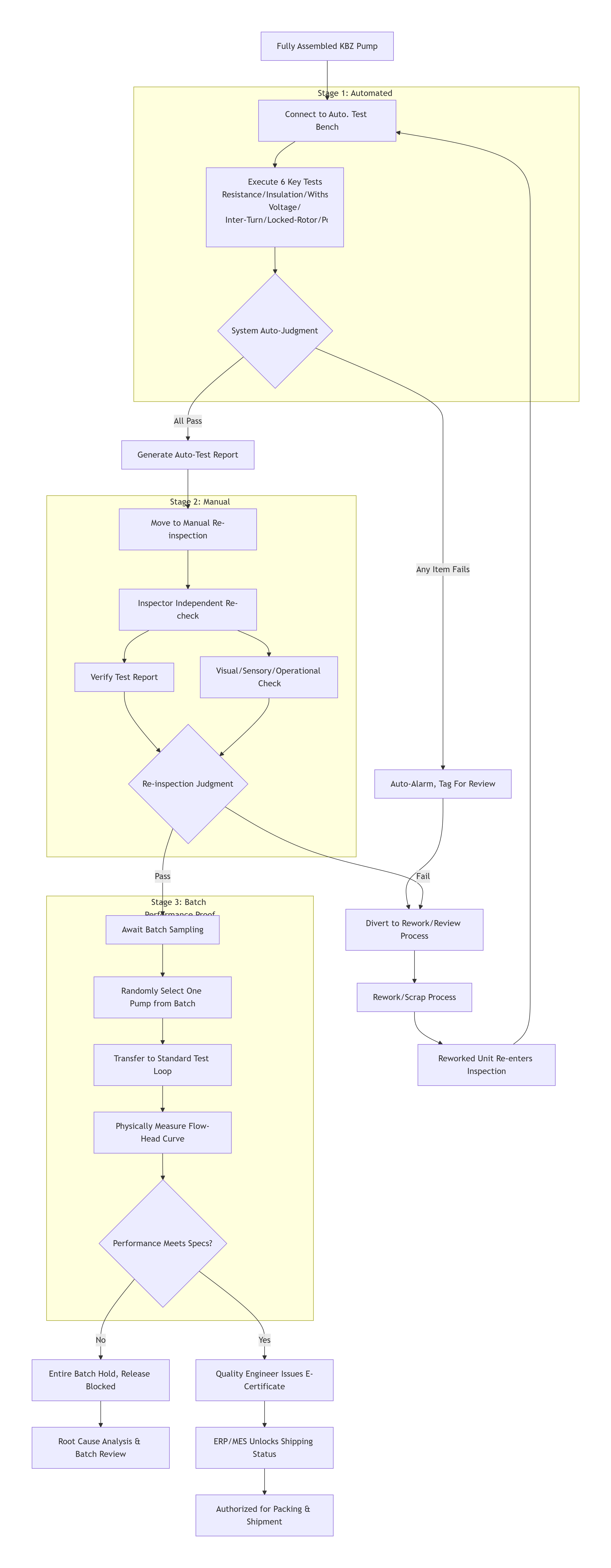
Stage 1: Automated Comprehensive Performance Testing on the Line (Primary Objective Screening)
Fully assembled KBZ pumps are first connected to a Fully Automated Comprehensive Test Bench. Program-controlled to simulate operating conditions, it sequentially performs rapid and accurate testing of six critical electrical and performance parameters:
1. DC Resistance Test: Checks the uniformity of motor winding conductors and connection integrity.
2. Insulation Resistance Test: Measures the insulation strength between windings and the housing, ensuring absolute safety in damp environments.
3. Power Frequency Withstand Voltage Test: Applies high voltage significantly above the rated value for a specified duration to test dielectric strength and eliminate potential insulation flaws.
4. Inter-Turn Insulation Test: Compares pulse waveforms to detect weak points in the insulation between winding turns, preventing early failure.
5. Locked-Rotor Test: Measures locked-rotor current and torque at startup to verify motor starting characteristics and compatibility with protection devices.
6. No-Load Power Test: Measures input power and current during no-load operation, assessing motor manufacturing quality and core losses.
All test data is automatically collected, judged, and reported by the system. If any item fails, the test bench alarms automatically, and the pump is tagged "For Review" and diverted to the rework channel.
Stage 2: Inspector's Comprehensive Re-inspection (Manual In-Depth Verification)
Pumps passing the automated test do not proceed directly. They are moved to a re-inspection area for an independent, thorough secondary check by a dedicated final inspector. This stage focuses on:
· Verification & Confirmation: Reviewing the authenticity and completeness of the automated test report, confirming all parameters are within standard limits.
· Sensory & Visual Inspection: Checking paint quality, nameplate security, fastener status, cable sealing, and other aspects difficult for automated equipment to fully assess.
· Operational Sound Monitoring: Listening for abnormal vibrations or noises during low-voltage or brief powered operation, leveraging inspector experience.
· Protection & Packaging Check: Verifying that anti-corrosion and protective measures for key parts like the shaft extension and flanges are in place.
This step provides essential complementarity and authoritative confirmation to the automated testing, effectively guarding against risks from equipment misjudgment, parameter drift, or procedural omissions.
Stage 3: Batch Performance Sampling & Physical Validation (Engineering Capability Proof)
After completing electrical safety checks for all individual units, to validate the core hydraulic performance of the complete pump under real operating conditions, we enforce the following sampling rule:
· At least one KBZ pump is randomly selected from each production batch (or a predetermined quantity).
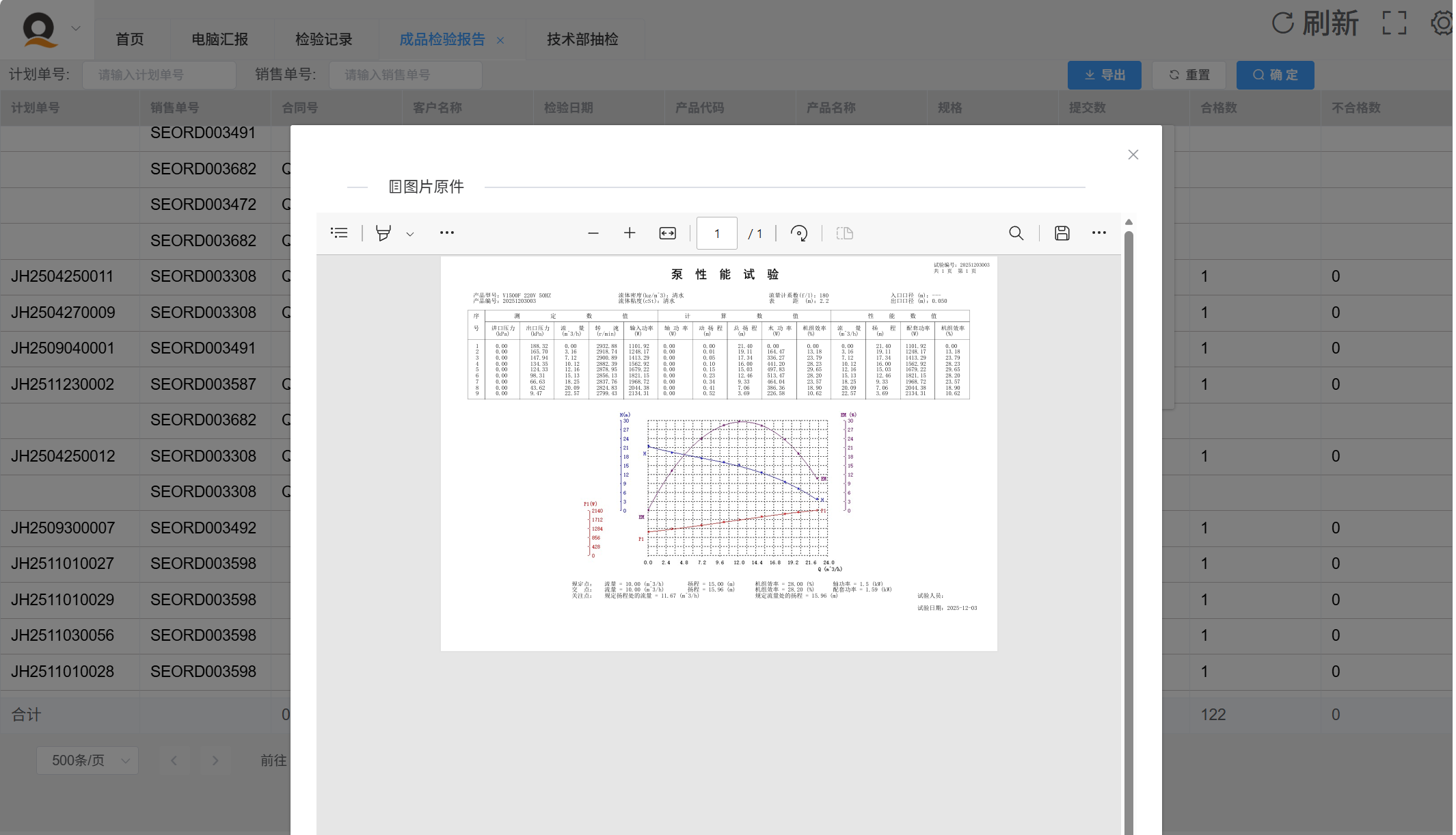
· The sample is sent to a standard closed test loop to physically measure its Flow Rate vs. Head curve under rated voltage and frequency.
· The measured data is compared against the product design standards and the batch's technical specifications to confirm key metrics like efficiency, flow rate, and head are达标 (meet requirements).
Sampling validation serves as the "touchstone" for testing the consistency of manufacturing and conformance to design for the entire batch, representing its quality level from a statistical standpoint.
Process Overview: KBZ Submersible Pump Final Inspection System
The diagram below systematically illustrates the entire quality control and decision-making process from final assembly completion to release for shipment:
KBZ final inspection process
Conclusion: Value Beyond Standards
The significance of the KBZ submersible pump's final inspection system extends far beyond meeting national standards or contract clauses. By combining:
· Objectivity with Subjectivity, it compensates for the limitations of any single inspection method.
· 100% Checking with Sampling, it controls individual unit risk while validating overall batch performance.
· Data with Experience, it allows digital reports and professional judgment to support each other.
This system ultimately builds the ultimate trust of our customers in our products. We understand deeply that a reliable submersible pump is crucial to the stability of a drainage system, and even to the safety of a project or a community. Therefore, we guard this final "iron gate" with the utmost strictness.
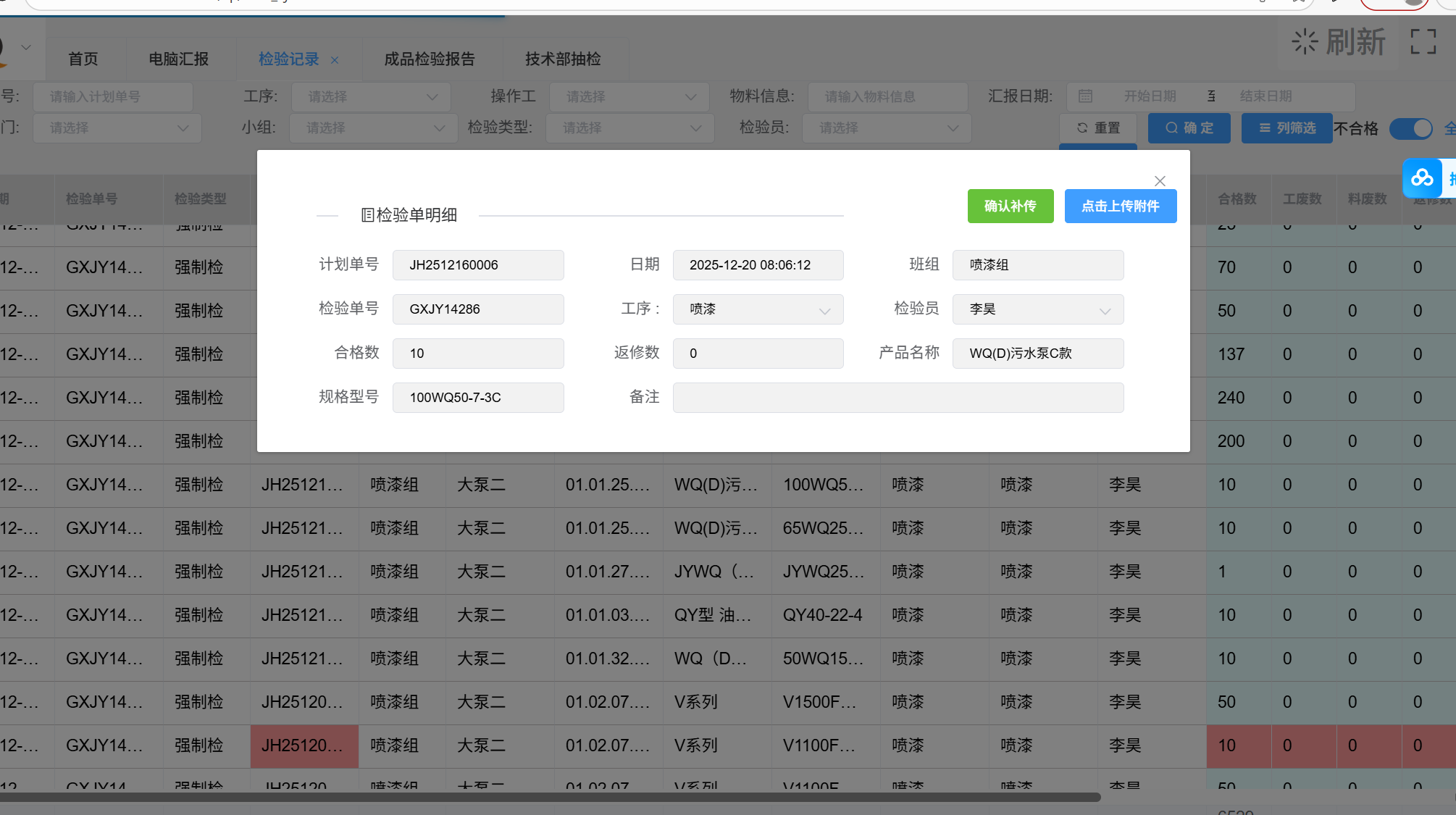
This is the MES final inspection record
Test flow head record


 Vincent@kraup.com
 0086-158 8857 7896
 0086-576-86312805
 The industry of Plastic Zone,Daxi Town,Wenling City,Zhejiang Province, China
Copyright © 2025 Kraup® All Right Reserved. Designed & SEO by followala.cn Sitemap | XML
Friendship Cooperation - Qruck Product: VIC Grooved Hose Coupling | Storz Coupling | Global Coupling | Storz Fittings | Fire Fittings | Custom Fire Fittings
Encapsulated Motor | Water Cooled Motor | Oil Cooled Motor Submersible Well Pumps Fountain Pump
 Home
Home Products
 Company
 Contact Us